
Sunday, May 25, 2014


Thursday, May 8, 2014
I Am Not Different.
I think I read this somewhere recently: “Feminist until a girl is married”.
Strangely, I think I have never felt more anger towards the issue of female repression since
I was married. I guess, one really needs to be over into the dark side to know
the extent of monstrous holy mess that constitutes it’s core.
Needless to say, the moment a woman marries, she opens her
life to a barrage of inappropriate questions related to her womb—when do you
plan to have kids, how many, and the onslaught continues. Perhaps, men get
asked the same question too, but let’s get real, woman’s fertility is often
synonymous with her ability to find and even retain a groom in India at least.
However, let me set the record straight: I am a feminist, I
am married, and no I don’t have any plans of bearing children. This is my
choice at the moment.
I feel that everything we do in life has to be a conscious
decision. Often times, some things become so conditioned, that we go on doing
the same thing on auto-pilot without even realizing the purpose of the task at
hand. In this age of science, this level of blindness does not appeal to me. If
everything is a conscious choice, then many life decisions about education,
relationships and family must be questioned and examined. Only when one finds
an answer that satisfies them or appeals to their sensibilities should the path
be chosen. While this is a general guideline, following it is often associated
with many challenges. Since most of my critics originate from my country of
nationality: India, I will focus this article to the ambit of Indian society. In
Indian society, collective tendencies dominate and there is little if no room
for individual sentiments. While collectivism is a brilliant thing, and
makes us thrive in the sense of community, it brings with it an ugly monster of
conformity. Think of it as the evil twin of collectivism. Brother Conformity
wants everyone to follow a path that has more or less been followed by everyone
before. Any deviation is frowned upon, and attributed to some character flaw.
To illustrate: a woman’s choice to not marry consciously would be ascribed as a
flaw with her personality or the misalignment of her nakshatras.
These aspersions usually find their way to women for some
reason, I guess since the collective expectation of society from it’s women is
high. The minute a deviant comes
to the foreground, all hell breaks lose- she is deemed “different”,
“eccentric”, “selfish”. But this is just a woman exercising her individuality,
her right to make a decision and break the conditioned patterns. I think I can hear the woman saying: my
choices are my own, I am not different, I am me.
Monday, April 14, 2014
Monsoon Child
Living in Europe, I would often
come across these words whenever Madrid was accosted by dark rain clouds “ depressing”, “dreadful”, ”awful”, and
the list goes on. It was cited as the number one cause for being lethargic, not
wanting to work, and basically being blue (or grey in this case). Coming from
hot India – Delhi, to be precise, its dust laden roads testament to its
aridness, I, on the other hand have almost always welcomed dark clouds and rain
with a little internal jig like this.

http://www.funnyordie.com/lists/1d2da3358d/the-best-dancing-gifs
Anyway,
I thought it was us Indians who have a penchant for this strange behavior, when
people in higher latitutdes with the cold and dark are driving themselves over
the edge (literally), because there is such a thing as seasonal affective
disorder. People even report lower life satisfaction on rainy days! [1]
I
understand that if it is cold and rainy for sustained periods, which it is in
many parts of Europe, people feel their lives are restricted, and this could
dampen people's plans and so forth. However, I thought this certainly wouldn’t
hold for Indians! We of the monsoons, and such!
In
India, farmers from ages ago depended on the south-west monsoon when irrigation
facilities were non-existent. Imagine depending on rain for your survival!
Besides, considering that we get majority of our rain in the summer months when
temperatures are pushing upwards of 40 degrees celsius, it is no wonder we pray
to all gods known to us to let it rain! It is tough to let go of that deep
sense of attachment to something that resonated with joy for people in the
subcontinent for thousands of years.
The
origin of the word monsoon is not that surprising to people in Asia atleast.
Monsoon arose from the Arabic word “mausim”
which basically means weather, which of course is a commonly used word in
Northern-India “mausam”. Hell, we
even have some Bollywood movies with that name.[2]

In India, we also have a raga in
Indian classical music known as Malhar.
This raga is often associated with rains and monsoons. I remember as a kid, watching a movie
where Tansen, the court singer for Akbar, was asked to sing raga Deepak to light the lamps in his court,
but on doing so, Tansen started to burn from inside and then someone had to be
brought to sing Malhar, to bring rain
and cool his body.[3]
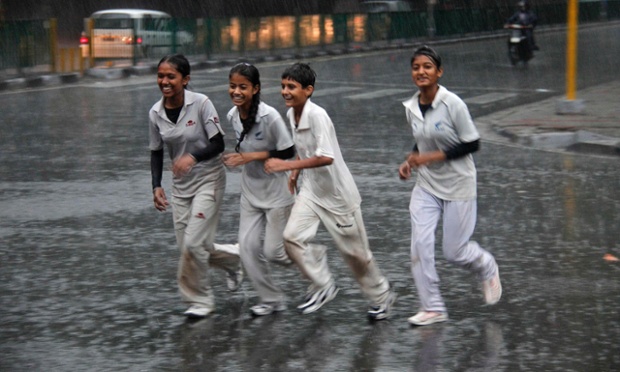
Whenever I am in India during the
monsoon season, I always come across kids, so many of them dunking into
makeshift pools and dancing in the rain. Everyone has a smile on their face, no
matter if they have to wade through knee-deep water (myself included). So
collectively, the Indian conscience revels at the site of rain clouds and
monsoons and rain!
http://www.theguardian.com/news/2013/jun/13/the-best-news-photographs-of-the-day
As I am writing this, I am
listening to raga Malhar by Pandit
Jasraj, hoping some of that magic would rub off here in Hong Kong and make it rain. I do see clouds in the distance.
I think this song from Lagaan,
set to the exquisite music of the genius A.R. Rahman, embodies the sentiment
that people often experience at the prospect of rain.
Sunday, March 9, 2014
No Celebration for Me.
I don’t care much about these Hallmark holidays, but
considering International Women’s day is touted as something much more than
that, I was willing to give it another chance. Until I got an email from Jet
Airways, Body Shop, Aldo and every other brand asking me to spend my money on
things, aka shopping. So, true, brands need consumers to buy them, but sending
emails on the pretext of a women’s day – a day to ostensibly celebrate
achievements of women, and
bombarding me with discounts that could be sent on any other arbitrary day too,
had me a bit irked to say the least.
I saw countless pictures and posts on Facebook and Twitter
extolling the self-sacrificing, brave spirit of women. Maybe there is something
to it, these days, when we post random quotes and pictures, and thank the women
in our life, and then conveniently forget all that transpires the rest of the
year.
In order to celebrate all that a woman has done, she needs
to be accepted and acknowledged in the mainstream society. She needs to be
understood and accepted with the same mores that apply to men.
Here are instances when our society has failed on that
front:
1. A little girl goes to play football with the boys in the
neighborhood since she doesn’t want to sit inside and play with dolls- and she
gets teased and made fun of by the boys.
2. A girl decides to not marry and is judged either to be promiscuous
or a spinster (depending on how she is perceived by the society)
3. A woman decides to be assertive in office and is
henceforth known as “Bossy”
4. A woman decides to pursue her career instead of her
husband, and is constantly made to feel guilty by all around her.
5. A woman gets called selfish if she decides not to have
children.
6. A woman must earn less than her male partner or be less
qualified than him – is the “conventional” wisdom. If not, his ego may not be
able to handle it. This will not translate into marital bliss. Is what is
prescribed in our society.
7. Assumptions that all women like babies, kittens, clothes,
gossip, spas and such.
I feel many of these instances I described are stifling for
men as well. What if a guy wants a kid, what label does he earn? What if he
likes spas? By apportioning one end of the spectrum for a certain gender, we
preclude the other gender from those engaging in those behaviors or activities
without attracting a raised eyebrow. That is unfair.
Can’t we envision a genderless world, where blue and pink
are just colors and not identifiers for a baby boy or baby girl.
Where girls playing football, and boys playing with castles
and dolls is not only accepted but encouraged? I think until we achieve that
ideal, I am not celebrating any International Women’s day (or Men’s day for
that matter).
Wednesday, February 26, 2014
Nowhere. Everywhere.
As I sit here in the dead of the night, like it always
transpires with me and my insidious inspirations, I realize, I am sitting on
the cusp of a big change. It doesn’t unfaze me in the least. If anything it
makes me feel curious, excited, and a thimbleful of happy.
 Just a week back I was in Madrid, packing four years worth
of life in garbage bags and suitcases. Throwing some, sending some across the
seas onto another continent. I said goodbye to precious memories, and special
friends, and a city which had embraced me like I was it’s own. When I close my
eyes to this day, I can imagine walking down my street- Calle San Vicente
Ferrer, upto Tribunal in the bleak winter sun. And this memory will remain me
with me for eternity. For even though my mind is here, my heart often wanders
onto those precious streets of Malasaña where I found love, friendship, but
more importantly myself.
Just a week back I was in Madrid, packing four years worth
of life in garbage bags and suitcases. Throwing some, sending some across the
seas onto another continent. I said goodbye to precious memories, and special
friends, and a city which had embraced me like I was it’s own. When I close my
eyes to this day, I can imagine walking down my street- Calle San Vicente
Ferrer, upto Tribunal in the bleak winter sun. And this memory will remain me
with me for eternity. For even though my mind is here, my heart often wanders
onto those precious streets of Malasaña where I found love, friendship, but
more importantly myself.
Picture (Top): Musicians Perform at C/ Fuencarral, Madrid

 I am in another continent now, Asia. European charm has been
traded in for the oriental grace and efficiency in Hong Kong. As I write my
thesis these days, I miss my other homes. Guangzhou, Delhi, Goa, Madrid – in no
particular order. I miss the peculiar smell of fish and fenny in Goa. I miss
the musty car park smell of the basement in Guangzhou. I miss the burned embers
of tandoor crackling in the winter night, mixed with smog, assaulting the senses
with a smell that is quintessentially Delhi. And the distinct wetness in the
air during
I am in another continent now, Asia. European charm has been
traded in for the oriental grace and efficiency in Hong Kong. As I write my
thesis these days, I miss my other homes. Guangzhou, Delhi, Goa, Madrid – in no
particular order. I miss the peculiar smell of fish and fenny in Goa. I miss
the musty car park smell of the basement in Guangzhou. I miss the burned embers
of tandoor crackling in the winter night, mixed with smog, assaulting the senses
with a smell that is quintessentially Delhi. And the distinct wetness in the
air duringmonsoons and the thrill of an unseasonal rain that beckoned all the children of Delhi out onto the streets. Home is usually synonymous of the country and city you lived in or the place where your parents live in. Often these two coincide. Many times they don’t.
I often wonder – What
is my home? Delhi? Yes, I did grow up there, but I don’t have a home there
anymore. My grandparents do live there, but my parents don’t. Is it Hong Kong?
My parents live here, but I haven’t ever lived here and I won’t in another
couple of months. Madrid? No, not since I set sail a week ago. Does that imply I don’t have a home
anymore? Maybe. Does that bother me? Not in the least. “Settling down” is a
term that didn’t manage to endear itself to me. So this phase of abandon and being
without an anchor as such should be right up my alley.
Picture (Top-Left):Gurudwara Bangla Sahib, Delhi
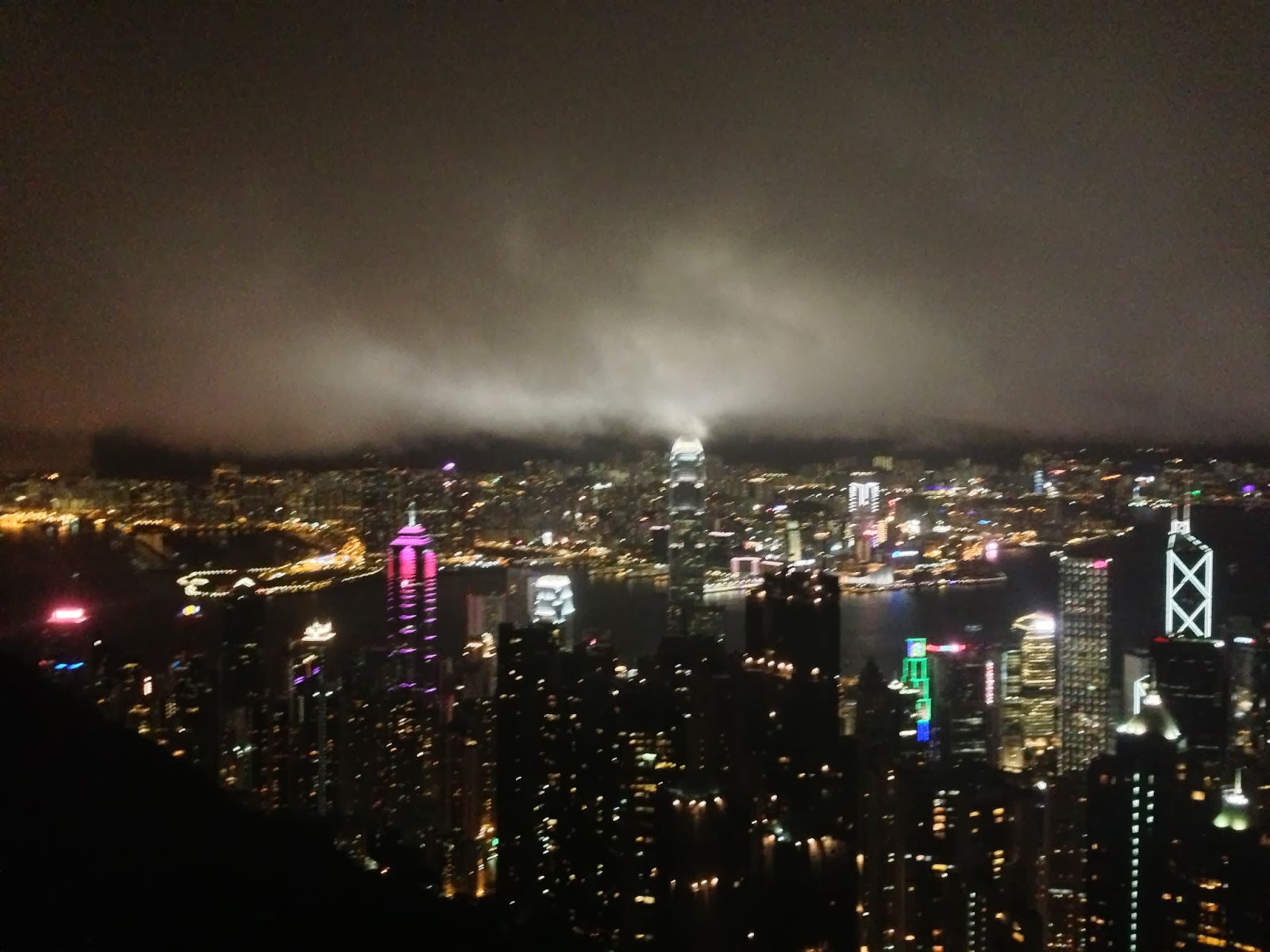
Picture (Bottom-Left) : View of Hong Kong from the Peak, Hong Kong
Picture (Bottom-Left) : View of Hong Kong from the Peak, Hong Kong
 Maybe there is a reason I don’t have a “place” to call home.
Perhaps since hypothetically every place could be my home. Why must I limit
myself in a geographic sense? (1)
Maybe there is a reason I don’t have a “place” to call home.
Perhaps since hypothetically every place could be my home. Why must I limit
myself in a geographic sense? (1)
Perhaps, I am looking at it all wrong. Maybe as Emily
Dickinson said it “Where thou art – that–
is –Home.” (2)
Combining (1) and (2) above: I am here, right now, this
moment, this is home. This is nowhere. This is everywhere.
Tuesday, January 28, 2014
Drink the Damn Chai
I am not the biggest fan of the “loud” ostentatious culture of
Punjabis here in Delhi (my family included). We are indeed boisterous (very), flashy (sparkly/blingy) and over the
top friendly. But when we offer you that beverage for the 20th time,
we really really want you to drink it. And we mean it.
Punjabi culture is showcased often in Hindi movies, and
perhaps that is how the rest of India sees us – tandori chicken eating, whiskey
drinking, dancing brutes.
Most of it may be true for many of us, there are exceptions
too. For instance, I know many families who prefer seekh kebabs over tandoori
chicken.
Anyway, the point is that – we may like our loud Djs in
shadis, dancing uncles and our “shoo-shaan” (shosha) but we mean well.

I mean most of us** Punjabis were refugees less than 65
years ago. We came here with just the clothes on our backs and if we were lucky,
our family members. We build our lives from the camps in refugee settlements.
We had to prove ourselves in a new land, a land far away from our home in
Multan or DI Khan or Rawalpindi. We had to compete with each other for the
packs of “rotis” given to refugees,
which were limited in supply. We had to fight to get an allotment of homes in
the first refugee colony in Delhi. This made us feisty, no doubt, but it made
us adventurous too. It made us strong and resilient.
When we gush over you and ask about your well-being we
aren’t being fake. No one asked us these questions when we had nowhere to go.
So just tell us that you’re doing ok, and don’t berate us for being loud.
And when we offer that chai
to you again and again, take it. We aren’t showing off our tea making
abilities. Back in the day, we didn’t have any chai, and maybe we just want you to share our happiness.
** us/our grandparents/ancestors
Tuesday, January 21, 2014
Radiance of our being
With Aam Admi
Party (AAP) and Somnath Bharti thronging the airtime on major news channels,
somewhere in the background the issue of race was touched upon. There was much
furore caused by the alleged presumption on part of Mr.Bharti when he was
allegedly acting on complaints by residents of Khirki village against certain
Uganda nationals. What transpires on these allegations in the end, is not the
point of this piece of work. Many articles have since then come up about the
racism prevalent in India (you can read one here)
and while it does ring a bell, and makes me nod my head acknowledging that there is xenophobia that pervades our nation, it also gets me thinking.
I think xenophobia is a very real problem in India, but I
think discussing this is essentially premature – us getting too far ahead of
ourselves. Perhaps it is important to address a topic closer to home –the
discrimination prevalent and entrenched in our society itself.
Indians love fair skin. It’s not completely random though.
The ancient Indians were Dravidians who were much darker skinned then what we
see today. Of course the fairer-skinned Aryans coming in from north-west and
pushing the Dravidians south ensured that North India was predominantly lighter
skinned than South.
As the caste system began to spread it tentacles in ancient
India, darker skinned became associated with menial, hard labour – ergo the
lower class, and a lighter complexion was often symbolic of higher castes. The Britishers followed, the ruling
elite, the fairest of them all. Their power, position and appearance became
something to be aspired for. Given this historical and sociological
perspective, it is understandable (though not acceptable to say the least) that
Indians are obsessed with fair skin (for the most part).

Fair and Lovely cream, manufactured by Unilever is the most
popular cream in India for skin lightening (I can’t vouch for its effectiveness
of account of never having used it). So popular it is that now there is a Fair
and Handsome cream manufactured by Emami and endorsed by a top Bollywood actor
–targeted for men! Corporates behind these brands often argue that if one uses
makeup to feel and look good, then looking fair is a choice too, and something
that people should not be denied. While I have to give them credit for this
ingenious rationale, I must say I am not buying it (the argument or the cream).

Source: Data for
native populations collected by R.
Biasutti prior to 1940.
One would think that a country with such shades of skin from white-peaches
complexion of the people from Kashmir and Himachal, to the wheatish color of
the dwellers of the northern-plains, and the dark and caramel complexion of the
people from south, and many many shades in between, we would be more tolerant
and accepting of this myriad of shades, but instead, capitalist propaganda
feeds of our insecurities and archaic social traditions to forward their own
interests. Yet, it’s not all a commercial argument at the end. Men and women
seeking out matches on portals for marriages want someone who earns well, is
understanding and sweet, and oh of course, Fair! And may shame fall upon the
family that gets a dark daughter in-law! Tch tch!
In the light of all these biases, it’s no wonder that we are
xenophobic. And mind you this is a shade-y xenophobia. Indians will embrace all
things white (Americans, Russians, British, etc,), take photos with them
outside Taj Mahal. But the darker of the lot? No sir, we don’t like foreigners.
But why should we? When we can’t tolerate our Indian
neighbors who speak another language and look a little different. Is this
xenophobia or just ignorance? Are we
confusing darkness of the skin for darkness of the soul?
“Gori hai kya”(Is she
fair?), “Kaali syah jaisi hai”(she is dark like ink)
With thoughts like these bouncing of the mouths and walls of
homes, how can you expect a young girl to grow up to be a self respecting woman
or your son to respect and appreciate different shades? Maybe before we ask
companies to stop selling these skin-lightening creams, we should look into our
own homes, and tell our children and mothers that color is a color, and just
that. Indeed, beauty does not know
color. I think amidst all this talk, we often lose sight of what is important–
the radiance of our being and not of our skin.
PS: I have to acknowledge the work of "Dark is Beautiful Campaign" (you can read about them here)

Thursday, January 16, 2014
10 Endearing Things about my India
1. Bhelpuri, Pani Puri and Aloo chat is a valid form of dinner.

Source: http://www.flickr.com/photos/74852128@N00/3107779760/
2. Wearing a dupatta and bindi with jeans and a tee shirt is
the coolest Indo-western attire.

Source: http://www.glamcheck.com/bollywood/2013/01/03/bindi-styles-indian-women/
3. How people become your best friend within an hour of
meeting them

Source:http://arunoday.blogspot.hk/2010/05/free-hugs-and-maa.html
4. How giving a missed call is an acceptable form of communication
5. All men driving buses, autorickshaws, serving chai and
other sundries automatically become bhaiya
– brother.
6. Bollywood and cricket unifies the nation more than any
other thing known to Indians
Source: http://cricketmademecrazy.blogspot.hk/2012/07/interesting-facts-about-sachin-tendulkar.html 
7. Nothing happens without a song and dance. Nothing.

8. Gujjiya on
Holi, Halwa on Ashtami, All forms of Mithai (sweets) on Diwali.


Source: http://shailbalasingh.blogspot.hk/2008/09/gujjiyas-kajuriya.html
9. How a mosque, temple, gurudwara
and church can all be found within a one kilometer radius.
****
Subscribe to:
Posts (Atom)